
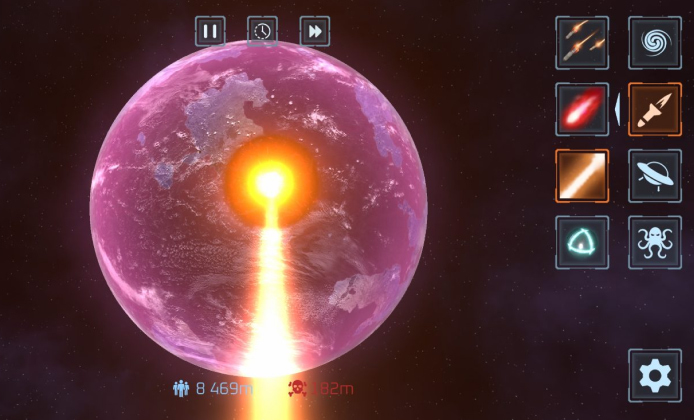
If you’re new to planetary sandbox games, Solar Smash is a fast way to learn how physics-style destruction, weapon selection, and timing work together. To begin smoothly, make sure your device meets basic performance needs, keep your display brightness comfortable, and turn on sound for clearer feedback during impact moments.
Many players start with Solar Smash free-to-play options because they let you explore weapons and scenes before committing to any extras.
Getting Started in Minutes
Open the game, pick a planet, and take a moment to rotate the globe so you understand continents, oceans, and city clusters. Early sessions are best used to learn camera movement and how different tools scale from “surface damage” to “planet-ending” effects. As you practice, keep your sessions focused on Solar Smash play basics like aiming, zoom control, and switching between tools without rushing.
Quick Setup Checklist
- Lower particle effects if your device stutters during large explosions.
- Use headphones if you want to hear subtle cues like shield impacts and beam charge.
- Rotate the planet slowly to avoid missing target zones on the far side.
Core Controls and Camera Mastery
The camera is half the game: zoom in to place precise hits, then zoom out to track chain reactions. The most satisfying moments usually come from carefully layering smaller damage first, then escalating to higher-power tools once weak points appear.
For consistent results, try to play Solar Smash with deliberate pacing, because rapid random taps often waste your strongest weapons.
Weapons, Effects, and When to Use Them
Solar Smash rewards experimentation: lasers carve, meteors crush, missiles spread damage, and exotic tools can trigger huge systemic failures. If you want a “clean test,” choose one weapon and repeat the same strike pattern across different planets to compare outcomes. When you want variety without pressure, you can play Solar Smash for free in short creative bursts and treat each run like a mini experiment.
Modes and Goals You Can Create for Yourself
Because it’s a sandbox, your “win condition” is whatever you define: precision strikes, speed runs, realistic destruction, or cinematic chaos. Try designing challenges like “no lasers,” “only impacts,” or “minimum strikes to collapse the core.” To keep progression feeling fresh, treat Solar Smash game play for free sessions as a rotating playlist of self-made challenges.
Challenge Ideas
- Three-strike limit: plan every hit.
- Shield breaker: remove defenses before touching the surface.
- Biome test: compare damage on desert vs ocean-heavy worlds.
- Satellite chaos: remove moons first, then finish the planet.
Playing on PC: Smooth Performance and Better Controls
Keyboard and mouse setups can make aiming feel more precise, especially for tight beam control and careful crater placement. If your computer has a high-refresh monitor, the motion of rotating planets can look noticeably cleaner. Some players prefer Solar Smash on PC free-to-play approaches to enjoy larger screens, steadier frame rates, and more comfortable long sessions.
Understanding Damage: What Changes and Why
Different planets respond differently: size, atmosphere, shields, and surface composition can change the same weapon’s outcome. Watch for early indicators like shield flicker, crust fractures, and heat glow, then decide whether to keep pressure on one region or spread damage globally. Once you recognize patterns, Solar Smash game play becomes less random and more like setting up satisfying chain reactions.
Recommended “Test Bench” Table
Use the table below as a simple reference for what to try first, depending on your goal. These are not rules just reliable starting points for experimentation.
| Goal | Best First Step | Follow-Up |
|---|---|---|
| Precise city damage | Zoom in and strike lightly | Rotate planet to compare regions |
| Crust cracking | Create multiple weak points | Escalate power once fractures spread |
| Total destruction | Disable shields early | Use a finishing tool after instability begins |
Troubleshooting and Best Practices
If performance dips, reduce visual effects, close background apps, and avoid stacking multiple high-particle tools at once. If controls feel slippery, slow your camera sensitivity and practice “tap, observe, adjust” rather than continuous clicking.
If you’re eager to jump in, remember Solar Smash free-to-play now experiences are most enjoyable when you tune settings first and avoid unnecessary lag.
Convenient Ways to Play Without Extra Hassle
Some platforms make it easy to revisit the game quickly, so you can test ideas in short breaks. Keep a small notebook of your favorite weapon combos so you can recreate cinematic outcomes later.
For casual sessions, Solar Smash play for free routines work best when you set a tiny goal like “one perfect crater” or “one clean planet split.”
Browser-Style Sessions and Short Runs
If you’re on a shared device or just want simplicity, there are setups where you can play Solar Smash no download and still focus on learning weapon timing and planet rotation. When you look for quick access, choose Solar Smash free-to-play online routes that feel responsive, keep your session stable, and let you experiment without friction.
Mini FAQ
- How do I improve fast? Repeat one scenario, change one variable, and compare results.
- What’s the most satisfying strategy? Build damage gradually, then use a single “finisher” for a clean climax.
- Why does the same weapon behave differently? Planet size, shields, and surface composition affect outcomes.


 Solar Smash APK: Safe Download & Install Guide
 Solar Smash Latest Version Guide: What to Check Before Installing
 Turn Planetary Chaos into a Big-Screen Spectacle With Solar Smash on PC
 Solar Smash Play Guide: Controls, Modes, and Destruction Strategies
 Guide: How to Play Solar Smash
 Top 10 Interesting Facts About Solar Smash